
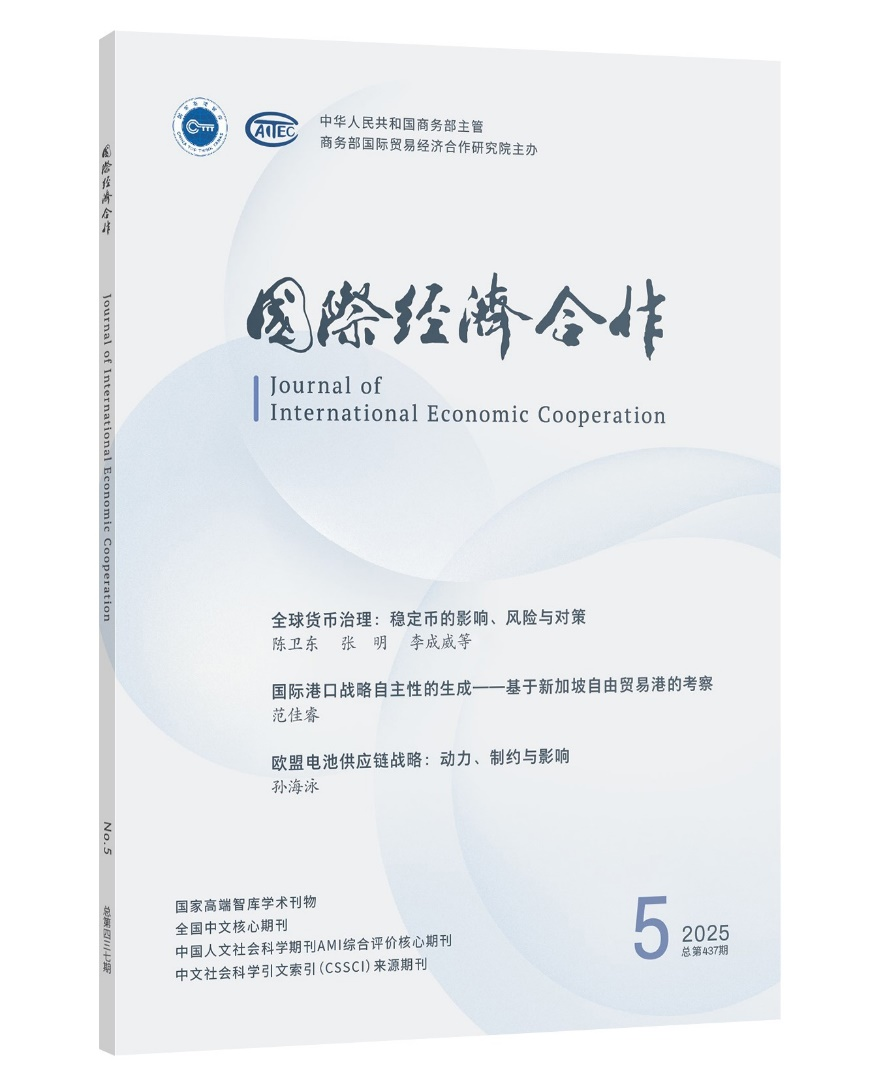
2025年第5期(总437期)目录
全球货币治理:稳定币的影响、风险与对策
陈卫东 张 明 李成威等
内容提要:货币是经济金融体系的支柱。随着技术创新、加密资产及去中心化金融的发展,稳定币逐渐兴起并成为全球发展最快的数字货币类型,引发对金融体系数字化与货币未来发展的高度关注。稳定币体现全球货币变革的新趋势,但稳定币不是真正意义上的货币,与传统货币架构不是“非此即彼”的关系。稳定币市场结构高度集中,其运行并非完全去中心化。全球稳定币快速发展,将在一定程度上改变全球支付清算格局,在部分新兴市场和发展中国家形成新的货币替代现象。随着全球稳定币市场复杂性上升,可能引发银行体系去中介化,加大资本流动管理难度,导致新兴市场面临加密化、美元化、美元武器化等诸多挑战。就稳定币对美元的影响而言,短期内,稳定币对美元的国际使用能起到一定支撑作用,长期看,稳定币难以从根本上缓解美元内生问题与美国经济发展存在的矛盾,并不能改变美元国际地位下降的大趋势。概而言之,稳定币的使用价值与功能空间仍有待实践检验。2022年以来,全球范围内稳定币监管体系建设步伐明显加快。对于稳定币及其未来发展,要保持清醒认知,中国一方面应主动融入全球稳定币发展浪潮,加大监管力度;另一方面,采取“两条腿走路”的策略,同步推进数字人民币与离岸人民币稳定币的发展。与此同时,稳定币背后的底层逻辑是数字货币竞争,本质上是以财政为基础的现代金融制度的竞争,因此中国参与全球数字货币竞争的核心在于夯实金融强国的财政基础。
关键词:全球金融体系 货币治理 稳定币 数字货币 加密货币
作者简介:陈卫东系中国银行研究院院长;张明系中国社会科学院世界经济与政治研究所副所长、研究员、博士生导师;李成威系中国财政科学研究院全球风险治理研究中心主任、研究员、博士生导师。
国际港口战略自主性的生成——基于新加坡自由贸易港的考察
范佳睿
内容提要:繁荣稳定的国际港口所在国往往具有一定战略自主性。国际港口在地理层面提升地缘塑造力,贯通世界物流网络,打造区域性关键节点的同时,又在机制层面建立全球关联性,辐射带动国际贸易流通,支撑全球治理体系。新加坡自由贸易港即新加坡通过对地缘环境的能动性塑造及对客观条件的创造性运用,以东南亚区域性关键节点的定位支撑全球航运及经贸体系运转的典型案例。该进程以全球化趋势为前提,逆全球化会阻滞其运转。在当今地缘政治回归、逆全球化回潮趋势下,对新加坡自由贸易港战略自主性的生成开展研究有助于启发他国能动性塑造自身空间环境,推动区域国别研究范式的发展。
关键词:国际港口 战略自主性 地缘塑造力 全球关联性 新加坡自由贸易港
基金项目:中国社会科学院“青启计划”资助项目(编号:2024QQJH186)
作者简介:范佳睿系中国社会科学院亚太与全球战略研究院副研究员,研究方向为全球海洋治理、地区安全治理、东亚及东南亚区域研究。
全球海底光缆治理的现实图景、多重模式与中国方案
郑海琦
内容提要:海底光缆治理问题关乎国家安全和经济发展,已成为国际社会关注的焦点,需要行之有效的治理模式。在全球海底光缆治理中,私营企业的主体地位突出,与政府的交叉程度日渐加深。海底光缆蕴含的数字标准是关键的治理客体,然而全球性标准缺位导致国家间难以形成合力,增加了海底光缆治理的成本和政策分歧。海底光缆在大国间形成新的相互依赖,同时刺激部分大国将相互依赖关系武器化。美国采取高度排他的治理模式,开展对华海底光缆竞争,试图建立美国及其盟伴主导的数字标准。欧盟推行联合自主的治理模式,在成员国之间建立海底光缆联合治理体系,减少海底光缆的对外依赖。全球南方国家呼吁更加包容多元的治理模式,希望增加海底光缆连接以促进发展。中国在共商共建共享的全球治理理念下,积极帮助全球南方国家建造海底光缆,合理安排项目资金来源,通过多边方式搭建全球海底光缆合作框架,并提供可靠的安全方案。中国需要加强与法国等发达国家以及全球南方国家的数字伙伴关系,在全球海底光缆标准和规则制定中发挥引领作用。
关键词:海底光缆 私营企业 数字标准 相互依赖 全球治理 基础设施
基金项目:国家社会科学基金青年项目“印度数字经济外交对中国的影响与启示研究”(编号:23CGJ051)
作者简介:郑海琦系中共中央党校(国家行政学院)国际战略研究院助理研究员,研究方向为印度外交政策、海洋安全。
欧盟电池供应链战略:动力、制约与影响
孙海泳
内容提要:在大国竞争不断升级、地缘政治回归并影响国际产业合作与供应链运行的背景下,提升电池供应链的自主性与韧性水平已成为欧盟电池供应链战略的核心目标。欧盟致力于通过产业政策强化市场保护与竞争壁垒促进产业内合作,以推动电池产业创新与产业项目发展。由于全球产业格局、欧盟要素禀赋等条件的影响,欧盟电池供应链战略面临诸多障碍。欧盟电池供应链战略对全球电池产业市场的竞争格局,中企对欧出口前景,以及全球碳减排进程等方面具有深远影响。对此,中欧双方需加强在电池标准、行业监管、供应链整合领域的合作,不断提升能源转型产业的竞争力。
关键词:电池 供应链 能源转型 欧盟 关键矿产 中欧关系
基金项目:国家社会科学基金一般项目“美国关键矿产供应链重塑战略与我国应对研究”(编号:23BGJ046)
作者简介:孙海泳系上海国际问题研究院公共政策与创新研究所研究员,研究方向为国际科技产业竞合等。
美国影响加拿大对华经贸政策的三种方式
赵行姝
内容提要:自2021年起,加拿大不断调整对华经贸政策,针对高科技研发与产业、关键矿产与新兴产业等出台一系列新政策。总体来看,加拿大对华经贸政策变动与美国极为相似,反映出加拿大在对华定位、安全关切、经贸理念方面的“美国化”特征。从成因上看,加拿大对华经贸政策调整离不开美国因素。美国通过利益拉动型、制度推进型、结构调整型三类政策传导方式影响加拿大对华经贸政策的方向。美国在对华全面竞争中有着深刻的战略考虑,预计特朗普第二任期将在经贸领域对中国提出更为严峻的挑战,加拿大对华经贸政策很可能继续朝着美国对华政策方向演进。
关键词:对华经贸政策 政策传导 中美关系 美加关系 联盟管理 特朗普
基金项目:中国社会科学院智库基础研究项目“特鲁多政府战略调整与中加关系前景”(编号:ZKJC242402)
作者简介:赵行姝系中国社会科学院美国研究所研究员,研究方向为美国能源与气候政策、全球能源与气候治理、加拿大对华政策与中加关系等。
中美欧数字贸易发展战略与政策比较研究
刘洪愧 李欣波 许尚坤
内容提要:数字贸易是全球贸易增长的重要引擎,中美欧均视其为重塑全球经贸格局的关键力量。通过对比分析发现,在数字贸易监管上,美国较为宽松,但实施双重标准;欧盟相对严格,采用“内松外严”的策略;中国已形成较为完善的监管体系,正在稳步扩大制度型开放。在国际化方向上,美国奉行霸权主义,欧盟实施战略防御,中国主张普惠包容。在重点关注产业上,美国重视数字技术与服务,欧盟重视数字内容,中国重视跨境电商。通过从经济发展水平、历史传统、安全关切和产业比较优势等方面探究产生上述差异的根源,并揭示中美欧三方在数字贸易领域的共同发展趋势和合作可能性,以期为中国加快建设数字贸易强国提供政策启示。
关键词:数字贸易 贸易政策 发展战略 国际比较 贸易强国
基金项目:国家自然科学基金面上项目“数字贸易开放对出口竞争力的影响:理论研究、实证检验与政策建议”(编号:72373161)、国家自然科学基金面上项目“国际生产网络视角下技术创新促进产业升级的机制和路径研究”(编号:72173132)
作者简介:刘洪愧系中国社会科学院经济研究所副研究员、中国社会科学院大学经济学院副教授,研究方向为国际贸易与投资;李欣波系中国社会科学院大学经济学院硕士研究生,研究方向为国际贸易与投资;许尚坤系中国社会科学院大学经济学院博士研究生,研究方向为国际贸易与投资。
中国援助对非洲经济增长的空间影响与机制分析
胡建梅 黄晓蕾
内容提要:中国援助对非洲经济增长的影响是中国对非援助效果评估的逻辑起点。基于2000—2021年中国对47个非洲受援国的面板数据构建空间杜宾模型,实证检验中国援助对非洲受援国经济增长的空间溢出效应及其作用机制。研究发现:第一,中国援助对非洲受援国的经济增长效应具有显著的空间溢出效应,且不同援助资金类型和不同援助部门的具体表现存在显著的差异;第二,中国援助通过推动非洲受援国产业结构合理化,间接促进其经济增长;第三,以经济体系空间结构衡量的区域经济发展状况在中国援助对非洲经济增长效应中发挥着显著的异质性调节作用。上述发现拓展了中国援助对非洲经济增长效应研究的空间维度和结构机制视角,为深化中非合作和提升中国对非援助效果提供了实证依据和政策启示。
关键词:对外援助 非洲经济增长 空间溢出效应 机制分析 经济体系空间结构
基金项目:国家社会科学基金一般项目“基于可持续发展目标的中国对非援助效果评估及优化策略研究”(编号:24BGJ025)
作者简介:胡建梅系河北工业大学经济管理学院副教授,河北工业大学京津冀发展研究中心研究员,研究方向为中国对外援助、国际发展援助;黄晓蕾系河北工业大学经济管理学院硕士研究生,研究方向为中国对外援助。
Global Currency Governance: Impacts, Risks and Countermeasures of Stablecoins
Chen Weidong Zhang Ming Li Chengwei et al.
Abstract: Currency underpins the economic and financial system. With technological innovation, the development of crypto assets, and the rise of decentralized finance, stablecoins have gradually emerged as the fastest-growing form of digital currency globally, drawing significant attention to the digitization of the financial system and the future evolution of currency. Although stablecoins represent a new trend in global currency transformation, they are not considered true currencies in the conventional sense, nor do they constitute a direct replacement for traditional currency architectures. The stablecoin market is highly concentrated in structure and is not fully decentralized in its operation. The rapid development of stablecoins globally may reshape the landscape of international payments and settlements to a certain extent, giving rise to new forms of currency substitution in some emerging markets and developing countries. As the global stablecoin market becomes increasingly complex, it may trigger disintermediation within the banking sector, complicate capital flow management, and expose emerging markets to challenges such as cryptoization, dollarization, and the weaponization of the US dollar. In terms of the impact of stablecoins on the US dollar, it may offer short-term support for the international usage of the dollar. However, in the long run, it cannot fundamentally resolve the issues inherent in the dollar and the US economy, nor can it reverse the overarching trend of the dollar’s declining international dominance. The practical utility and functional scope of stablecoins remain to be validated in practice. Since 2022, the pace of establishing regulatory frameworks for stablecoins has accelerated significantly worldwide. A clear-headed approach is essential in considering stablecoins and the future trajectory. For China, this entails not only actively integrating into the global wave of stablecoin development through enhanced regulation but also adopting a two-pronged strategy to promote the parallel development of the digital renminbi and offshore renminbi-based stablecoins. Furthermore, the underlying logic of stablecoins is digital currency competition, which essentially reflects a contest of modern financial systems based on fiscal strength. Consequently, China’s core task in the global digital currency competition is to reinforce the fiscal foundation of a financial powerhouse.
Keywords: global financial system, currency governance, stablecoin, digital currency, cryptocurrency
Shaping Strategic Autonomy of International Ports: Case Study of
Singapore Free Trade Port
Fan Jiarui
Abstract: Countries with prosperous and stable international ports typically possess a certain degree of strategic autonomy. International ports enhance geopolitical influence geographically by connecting global logistics networks and establishing regional key nodes, and institutionally, foster global connectivity, promote international trade flows, and underpin the framework of global governance. Singapore Free Trade Port exemplifies this regular pattern. It, through its proactive shaping of the geographical environment and creative utilization of objective conditions, sustains global shipping and economic and trade systems by functioning as a key regional hub in Southeast Asia. This process depends on the momentum of globalization, as deglobalization may hinder its functioning. In the context of the return of geopolitical rivalry and the rising tide of deglobalization, studying the shaping of strategic autonomy in Singapore Free Trade Port can inspire other countries to proactively shape their spatial environments and contribute to the development of paradigms for area studies.
Keywords: international port, strategic autonomy, geopolitical influence, global connectivity, Singapore Free Trade Port
Current Landscape, Multiple Models and China’s Solutions on Global Submarine Fiber Optic Cables Governance
Zheng Haiqi
Abstract: Submarine fiber optic cables governance, which is related to national security and economic development, attracts international attention and requires effective governance models. Within this governance, private enterprises occupy a prominent position as governance subjects, and their interaction with governments has been progressively intensifying. The digital standards embedded in submarine fiber optic cables have become the core governance object. However, the lack of global digital standards hinders international coordination, increasing the costs and policy disagreements on submarine fiber optic cables governance. Submarine fiber optic cables have created new interdependence between great powers, but stimulated some powers to weaponize interdependence. Against this background, the US has adopted a highly exclusive governance model to compete with China on submarine fiber optic cables, and attempts to establish digital standards dominated by the US and its allies. The European Union promotes a joint and independent governance model, which requires establishing a joint governance system for submarine fiber optic cables among member states and reducing external reliance. The Global South appeals for more inclusive and diverse governance models and hopes to increase cable connectivity to promote development. Under a vision of global governance featuring extensive consultation, joint contribution and shared benefits, China has actively helped the Global South build submarine fiber optic cables and reasonably arranged the sources of project funding. Moreover, China has established a submarine fiber optic cables cooperation framework through a multilateral approach and provided reliable security solutions. China needs to enhance its digital partnerships with developed countries like France and Global South countries, and play a leading role in the formulation of global submarine fiber optic cables standards and rules.
Keywords: submarine fiber optic cables, private enterprise, digital standard, interdependence, global governance, infrastructure
EU’s Battery Supply Chain Strategy: Drivers, Constraints and Impacts
Sun Haiyong
Abstract: Against the backdrop of escalating major power competition and the return of geopolitical rivalry influencing international industrial cooperation and supply chain operations, enhancing the autonomy and resilience of the battery supply chain has become the core objective of the EU’s battery supply chain strategy. The EU is committed to strengthening market protection and increasing barriers to competition through industrial policies to foster intra-industry cooperation, thereby advancing innovation and project development in the battery industry. However, due to factors such as the global industrial landscape and the EU’s insufficient factor endowments, the battery supply chain strategy is confronted with many constraints. Meanwhile, this strategy exerts far-reaching effects on the competitive landscape of the global battery market, the prospects of Chinese enterprises’ exports to Europe, and the global carbon reduction process. In response, China needs to promote cooperation with the EU in areas such as battery standards, industry regulation, and supply chain integration to continuously bolster the competitiveness of industries undergoing energy transition.
Keywords: battery, supply chain, energy transition, EU, critical mineral, China-EU relations
Three Mechanisms Underlying US Role in Shaping Canada’s Economic and
Trade Policies Toward China
Zhao Xingshu
Abstract: Since 2021, Canada has been changing its economic and trade policies toward China, introducing a series of new measures targeting high-tech research and development and industries, critical minerals, and emerging industries. Overall, these policy shifts closely resemble those of the US, reflecting the Americanization of Canada’s positioning toward China, security concerns, and economic and trade concepts. From the perspective of causal factors, these shifts are inseparable from the US influence. The US influences Canada’s economic and trade policies toward China through three policy transmission mechanisms: interest-induced, institution-driven, and structural adjustment. Given the US strategic calculus in its all-round competition with China, it is likely that the second Trump administration will pose more severe challenges to China in economic and trade areas, and that Canada’s economic and trade policies toward China will continue to align with those of the US.
Keywords: economic and trade policies toward China, policy transmission, China-US relations, US-Canada relations, alliance management, Trump
Comparison of Digital Trade Development Strategies and Policies Among
China, US and EU
Liu Hongkui Li Xinbo Xu Shangkun
Abstract: Digital trade has become an important engine for global trade growth, and China, the US and the EU all regard it as a key force in reshaping the global economic and trade landscape. Through a comparative analysis, this paper reveals that in terms of digital trade supervision, the US adopts a relatively lenient stance and implements double standards; the EU maintains stricter regulations and adopts a “domestically flexible, externally restrictive” strategy; China has established a relatively complete regulatory system and is steadily expanding institutional opening-up. In terms of internationalization, the US pursues hegemonism, the EU emphasizes strategic defense, and China advocates for inclusiveness. In terms of key industries, the US attaches importance to digital technologies and services, the EU prioritizes digital content, and China focuses on cross-border e-commerce. This paper uncovers the causes of the differences considering factors such as economic development levels, historical traditions, security concerns, and industrial comparative advantages. Based on this, it reveals the common trends in and possibilities for cooperation among the three parties in digital trade, so as to provide policy inspirations for China to accelerate its transformation into a digital trader of quality.
Keywords: digital trade, trade policy, development strategy, international comparison, trader of quality
Spatial Impacts of China’s Aid on Economic Growth in Africa and
Transmission Mechanisms
Hu Jianmei Huang Xiaolei
Abstract: The impact of China’s aid on economic growth in Africa represents the logical starting point for evaluating the overall effectiveness of its assistance. Based on panel data covering China’s aid to 47 African recipient countries from 2000 to 2021, this study constructs a Spatial Durbin Model to empirically examine the spatial spillover effects of China’s aid on the economic growth of African recipient countries and the underlying mechanisms. The findings reveal that China’s aid exerts significant spatial spillover effects on the economic growth in African recipient countries, with notable heterogeneity across different types of aid funding and aid sectors. Moreover, China’s aid can indirectly promote economic growth by facilitating the rationalization of industrial structures in the recipient countries. Notably, regional economic development, which is measured by the spatial structure of economic systems, plays a significant and heterogeneous moderating role in the impact of China’s aid on economic growth in Africa. These results not only expand the analytical framework of the impact of China’s aid on economic growth in Africa by incorporating spatial and structural dimensions but also offer empirical evidence and policy insights for deepening China-Africa cooperation and enhancing the effectiveness of China’s aid to Africa.
Keywords: foreign aid, economic growth in Africa, spatial spillover effects, mechanism analysis, spatial structure of economic systems